When a child is preparing to attend a U.S. boarding school, parents have many questions:
Will the academics be too demanding?
Will my child make friends?
Will they remember to do their laundry?
And, perhaps most urgently:
Will they have anything to eat besides hamburgers and fries?
For many international parents, food is not a minor detail. It is a daily concern wrapped in love, anxiety and the suspicion that, without parental supervision, their child may attempt to survive for four years on instant noodles.
The good news is that students at American boarding schools do not eat burgers every day. The even better news is that many schools treat dining as an important part of student life.
A dining hall can reveal a great deal about a school: how it handles allergies, whether it understands different cultures, how it builds community and whether it believes teenagers should eat formally in jackets and ties—or simply turn up in a sweatshirt and locate the nearest bowl of mashed potatoes.
So, what do students actually eat at U.S. boarding schools? And can they order food delivery when homesickness suddenly creates an urgent need for bubble tea?
Let us take a closer look.
First Things First: Is the Food Safe?
Before discussing sushi, dumplings or pizza ovens, families should begin with a less glamorous but far more important question: can students eat safely?
At Phillips Exeter Academy, students can receive individual support from a registered dietitian for allergies, dietary restrictions, sports nutrition and general wellbeing. Its dining facilities are designed to accommodate a wide range of dietary needs while reflecting the cultures, religions and backgrounds represented on campus.
Exeter’s new Hahn Center includes a modern kitchen, an in-house bakery and an expansive dining area. In other words, it is considerably more sophisticated than the average family kitchen—especially one in which the air fryer has quietly become the most hardworking member of the household.
At most boarding schools, students with allergies, medical dietary requirements or religious restrictions are expected to report them before arrival. Vegetarian, vegan and gluten-free choices are also increasingly common.
Parents should provide complete information rather than assume their child will “figure it out.” Teenagers are wonderfully capable people, but the same child who can analyse Shakespeare may still forget to ask whether a sauce contains peanuts.
Students should also learn how to explain their dietary needs directly to dining staff. This is one of the first practical lessons in boarding-school independence: Mum may know exactly what you cannot eat, but Mum will be several time zones away.

No, It Is Not Burgers Every Day
A persistent myth about U.S. boarding schools is that students eat hamburgers, fries and pizza from September until graduation.
These foods certainly appear. Teenagers would probably organise a protest if they did not. But they are only part of a much broader menu.
Many schools offer international dishes, themed food stations, salad bars, deli counters, vegetarian options and meals inspired by different cultural traditions.
At Northfield Mount Hermon, students have access to hot meals as well as extensive salad, cereal and deli bars. One NMH student from Hong Kong described the school’s Friday food bars—including bánh mì, bibimbap and burritos—as a favourite part of campus dining.
That is quite a long way from eating a lonely cheeseburger every evening.
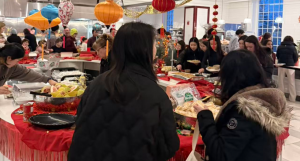
Schools also use food to recognise cultural and religious celebrations. During Lunar New Year, students may find dumplings on the menu or be invited to make traditional food together.
Barry, one of our students at Exeter, shared that the school prepares special dishes for holidays and has invited students to make dumplings together. Of course, whether every dumpling survives the student-folding process looking like a dumpling is another question—but the sense of community is very real.
At Westtown School, our student Logan even reported that the school’s kung pao chicken was surprisingly authentic. Coming from an international student, this may be one of the highest compliments a U.S. dining hall can receive.
Will every Asian dish taste exactly like home? Probably not. A dining-hall interpretation of fried rice may still cause some students to pause thoughtfully before identifying it.
But the effort matters. Familiar food can reduce homesickness, create conversation and reassure international students that their culture has a place within the school community.
When the Vegetables Have a Campus Address
At certain boarding schools, students do not simply eat the vegetables. They may know where the vegetables grew—and may even have helped grow them.
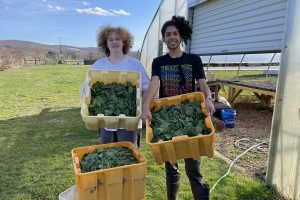
Fairfield Farm at The Hotchkiss School is an education-focused working farm connected to the school’s dining programme. It also gives students opportunities to study sustainable agriculture, ecosystems, food production and social questions surrounding the way communities grow and distribute food.
The farm can support learning across different subjects. Environmental science students investigate ecosystems, artists work outdoors, writers draw inspiration from the landscape, and history students examine the relationship between people and land.
Similarly, Big Red Farm at The Lawrenceville School includes four acres of cultivated land, 20 acres of pasture and three greenhouses. Students can participate through internships, volunteer work, academic projects, house activities and community service.
This means the farm can become:
- a biology laboratory;
- an environmental-science case study;
- an economics lesson about supply and demand;
- an ethics discussion about sustainability;
- a source of data for mathematics;
- and, after all that intellectual work, lunch.
For some students, discovering that vegetables require actual planting, patience and labour may also produce a new appreciation for whoever previously placed dinner on the family table every evening.
Formal Dinner or “Sit Wherever You Can Find Your Friends”?
Dining culture varies widely among boarding schools.
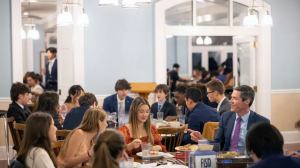
Some schools preserve formal or family-style meals. Students may dress neatly, sit at assigned or rotating tables and eat with faculty members. These meals teach social confidence, conversation skills and table etiquette.
They also teach students that checking a phone under the table is far less discreet than they imagine.
Groton School, for example, has a tradition of sit-down meals during parts of the school year. Students and faculty gather at mixed tables, helping students interact with people outside their normal classes, year groups and friendship circles.
For a child who benefits from structure, this environment can be extremely valuable. They practise speaking with adults, listening to different viewpoints and participating in a conversation even when their best friend is seated elsewhere.
Other schools take a much more relaxed approach.
At NMH, there are no assigned seats and no formal dress requirements in the dining hall. Students can choose where they sit, move between groups and eat in a comfortable atmosphere. The school’s salad, cereal and deli bars remain available for much of the day, which is helpful for students moving between classes, rehearsals, sports and other commitments.
This creates a very different social experience. A student may find themselves standing in line next to a teacher, coach or administrator and begin a conversation naturally—possibly while both are waiting for the last serving of potatoes.
Neither style is automatically better.
A formal system can help a quieter child practise structured social interaction. A relaxed system can make socialising feel less intimidating and more spontaneous. The important question is whether the dining culture suits the student.
During a school visit, families should therefore ask:
- Are there formal or family-style meals?
- Are seats assigned?
- How often do students dine with teachers?
- Is there a dress code?
- Must students attend every meal?
- What happens when sports, rehearsals or classes run late?
The answers may tell you more about the school’s culture than the dessert menu—although students may disagree.
The Dining Hall Is Also a Social Classroom
At boarding school, the dining hall is not merely the place where students refuel before returning to their homework.
It is where new students are invited to join a table. It is where teammates celebrate a win, classmates recover from a difficult test, and someone discovers that the quiet student from chemistry is actually very funny.
It is also where teachers may notice when something is wrong.
A student who repeatedly skips meals, sits alone or suddenly becomes unusually quiet may be having difficulty adjusting. Because teachers and residential staff often share meals with students, they can notice these changes in an informal setting.
This is one reason family-style dining can be valuable. A teacher does not need to begin with, “I would like to discuss your emotional wellbeing.” They can begin with, “How was your day?”
The conversation may remain about football practice or a history assignment. Or it may become the moment when a student finally admits that they are homesick, overwhelmed or finding it hard to make friends.
These ordinary interactions create a layer of care that cannot always be captured in a school brochure.
Sometimes pastoral support begins not in an office, but over soup.
The Question Every Student Really Wants Answered: Can I Order Food Delivery?
Usually, yes—but there are rules.
Boarding schools differ significantly in how they manage food delivery. Some allow students, particularly older students, to order food during designated hours or on weekends. Others impose stricter limits for safety, traffic control, waste management or to prevent students from treating the school dining hall as a purely decorative building.
When food delivery is allowed, students usually collect orders from a designated entrance, security point or student centre. Delivery drivers are generally not permitted to wander through campus in search of Dormitory B, Room 214.
Students may also have off-campus dining privileges depending on their age and sign-out permissions. Many schools organise weekend transportation to nearby supermarkets, shopping centres or towns.
However, families should not assume that a rule applying to a twelfth-grade student also applies to a ninth grader. Senior students may have greater freedom, while younger students may face more restrictions.
Before placing an order, students should check:
- permitted delivery hours;
- designated collection points;
- dormitory-specific rules;
- weekend sign-out procedures;
- grade-level restrictions;
- and whether the person delivering the food can actually find the campus.
School policies can change, so students should always refer to the latest handbook and ask their dormitory staff.
And parents may wish to discuss budgeting before giving a teenager unrestricted access to food-delivery apps. A single bubble tea may seem harmless. Seven bubble teas a week, plus delivery fees, can begin to resemble a small tuition payment.
Can Students Cook?
Some dormitories provide a shared kitchen where students can prepare basic food. Others restrict cooking because of fire safety, hygiene and supervision.
Even where kitchens are available, students should not expect to prepare every meal themselves. Boarding-school schedules are demanding, and the dining programme is designed to provide the majority of their daily meals.
Small appliances—including hot plates, rice cookers and air fryers—may be prohibited in student rooms. Families should check the school’s packing list before purchasing anything.
There is little point carefully transporting a rice cooker across the Pacific only to have it confiscated during the first dormitory inspection.
Shared kitchens can still play an important role in residential life. Students might bake together, cook a favourite dish, prepare food for a cultural celebration or attempt to recreate something from home.
The results may vary. The memories are usually excellent.
What About Snacks?
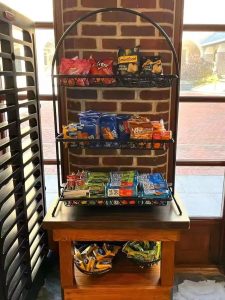
Most boarding schools have a campus store, café or student centre selling drinks, sandwiches, instant food, sweets and basic daily supplies. Schools may also provide weekend transportation to supermarkets or nearby towns.
Keeping some familiar snacks in the dorm can make the adjustment easier. A favourite biscuit or packet of noodles can be surprisingly comforting after a difficult day.
The challenge is balance.
Students should not replace proper meals with instant noodles simply because the noodles are conveniently located three metres from their bed. They also need to manage their spending, particularly when every snack, coffee and delivery is purchased digitally.
Parents may therefore want to agree on:
- a weekly snack budget;
- reasonable limits for food delivery;
- which foods can be stored safely in the dorm;
- and what their child should do if they are genuinely struggling with the school meals.
This conversation is considerably easier to have before the credit-card statement arrives.
What Should Families Look for During a School Visit?
A good boarding-school dining hall does not need chandeliers, marble floors or a chef who can produce a Michelin-starred soufflé.
Families should focus on more practical questions:
- Are allergens clearly identified?
- Is nutritional support available?
- Is there enough variety?
- Can the school accommodate medical, religious and cultural dietary needs?
- Are vegetarian, vegan and gluten-free choices readily available?
- How does the dining team respond to student feedback?
- Do students and teachers eat together?
- Does the dining hall feel welcoming?
- Are there options for students with late sports or rehearsal schedules?
- What are the rules for food delivery, snacks and cooking?
- What happens if a student is not eating well?
If possible, visit during a meal. Look at how students interact with one another and with the dining staff. Notice whether different groups mix naturally, whether teachers are present and whether students appear comfortable asking questions.
And yes, look at the food too. Your child will be eating it for the next four years. This is not the moment to pretend the menu is irrelevant.
Foundation Global Education’s Perspective
When evaluating a boarding school, families do not need to search for the most luxurious dining hall.
Look instead for safety, variety, inclusion and care.
A thoughtful dining programme supports allergies and dietary needs. It introduces students to different cultures while leaving room for familiar flavours. It creates opportunities for independence, conversation and connection.
Because at boarding school, the dining hall is never only about breakfast, lunch and dinner.
It may be where homesickness becomes a little easier to manage, where a student finds their first group of friends, where a teacher notices that someone needs support—and where an international student discovers, with great relief, that the school’s kung pao chicken is actually not bad.
Food feeds the student.
But a good dining community also helps the student feel at home.
Dining, delivery and residential-life policies may change. Families should consult each school’s latest student handbook and confirm grade-specific rules with dormitory staff.
To learn more about choosing and applying to U.S. boarding schools, contact Foundation Global Education.