A Mainland Chinese Student’s Path to Stanford Mathematics

January 29, 2026

Student Profile:


Name:

Amanda


School

International School in Guangzhou


Academic Profile

GPA: 4.00 / 4.00 (Unweighted)


Applicant Profile

A thinker and doer who combines mathematical rigor with humanistic insight,
and translates abstract ideas into real-world community impact


Admitted School

Stanford University


Intended Major

Mathematics


Selected Honors & Achievements

  • Harvard–MIT Mathematics Tournament (HMMT)
    • Top 100 Individual
    • Top 50 Team Ranking

  • American Invitational Mathematics Examination (AIME)
    • Score: 11 / 15
    AMC 10 & AMC 12 Distinguished Honor Roll
    (Top 5% Worldwide)

  • Physics Bowl
    National Gold Award
    • School Highest Score
    • Top 1.5% Worldwide

  • Mathematical Contest in Modeling (MCM)
    Outstanding Winner (Top 10% Worldwide)

  • High School Mathematical Contest in Modeling (HiMCM)
    Meritorious Winner (Top 13% Worldwide)

From a “Perfect Résumé” to Genuine Intellectual Thinking

In every U.S. college application season, an offer from the Mathematics Department at Stanford University feels like a crown jewel—especially for students from Mainland China.

With its ultra-low acceptance rate and exceptionally high academic bar, Stanford has long been regarded as one of the most competitive destinations in global higher education. Yet in the recently concluded Fall 2026 Early Action cycle, an FGE student, Amanda, earned admission to Stanford as a Mathematics major—through not only academic excellence, but a deeply authentic and intellectually grounded application narrative.

At FGE, we invited Amanda’s advisor, Kyle, to reflect on her journey and share insights into long-term planning, positioning, and personal growth.


Advisor’s Perspective

Kyle | Senior University Admissions Consultant, FGE

Kyle holds a Master’s degree in Education from Johns Hopkins University, and a Bachelor’s degree in Psychology from University of California, Davis.
With extensive experience in U.S. undergraduate admissions, he specializes in helping students uncover their unique intellectual identity and translating it into a coherent long-term admissions strategy—covering academics, testing, activities, school selection, essays, and interviews.

Kyle’s students have been admitted to institutions including Stanford University, Columbia University, Cornell University, University of California, Berkeley, University of California, Los Angeles, University of Michigan, Ann Arbor, and University of Southern California.


01 | Outstanding—but Missing a Story

First Impressions

When I first reviewed Amanda’s profile, her academic credentials were undeniably strong: an excellent GPA, multiple AP scores at the highest level, and clear readiness for top-tier universities.

But students with “perfect academics” are not uncommon in elite admissions pools. The real challenge was this:

How could Amanda stand out among equally accomplished peers?

Her activity list—mathematics research, music, cross-cultural organizations—was impressive, yet it read like a checklist. Each activity shone on its own, but together they lacked a unifying thread. The deeper question remained unanswered:

Who is Amanda, truly—and what defines her way of thinking?

This is a common dilemma for high-achieving students: abundant material, but no clear narrative.

Through in-depth conversations, the breakthrough emerged. What struck me most was not her résumé, but her mode of thinking. Amanda never rushed to provide “correct answers.” Instead, she questioned assumptions, examined premises, and patiently dissected complex systems. She showed sustained curiosity, intellectual patience, and a habit of structured reasoning.

This quality aligns precisely with what Stanford values as “Intellectual Vitality”—a genuine, intrinsic drive to explore ideas beyond utilitarian goals.
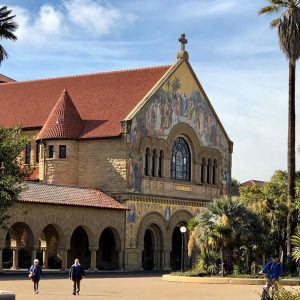
 

02 | Letting Go of “Perfection” and Embracing Authenticity

Positioning and Strategy

Over nearly six months, we continuously asked Amanda reflective questions:

  • Why have you stayed committed to certain pursuits for so long?

  • Which moments truly shaped how you think?

  • What underlying motivation connects these experiences?

Gradually, a core pattern emerged: Amanda excels at using rational frameworks to understand complex systems—and at exploring how those systems connect to real life and human experience.

This trait appeared not only in her love for mathematics, but also in her approach to music composition and cultural engagement.

We made a pivotal decision:
Stop pursuing a flawless, all-encompassing profile—and instead present a truthful intellectual journey.

A self-reflective, evolving thinker is far closer to Stanford’s vision of a future change-maker than a polished but impersonal “model applicant.”

School selection became a natural extension of this logic. Stanford’s emphasis on interdisciplinary exploration, intellectual freedom, and Intellectual Vitality resonated strongly with Amanda’s mindset.

Her long-standing engagement with Stanford programs—including Pre-Collegiate Studies in Grades 9 and 10, followed by acceptance into Stanford University Mathematics Camp (SUMaC) in Grade 11—served as both academic validation and a sincere expression of long-term interest.


03 | Making Every Application Component Speak

Execution and Deepening

Once the strategy was clear, our focus shifted to executing it consistently across all materials.

Activities List: From Enumeration to Narrative

Amanda’s original activities lacked visible community impact and felt academically isolated. Rather than adding new activities, we restructured and deepened existing ones.

  • Cross-Cultural Club
    Instead of simply listing her leadership title, we highlighted how she transformed abstract cultural concepts into lived experiences—through themed exhibitions, hands-on workshops, cultural visits, and online exchange platforms. This demonstrated her ability to turn ideas into tangible community impact.

  • Music Composition
    While many students play instruments, Amanda made the leap from performer to creator. We emphasized how she used music to express rational observation and structured thinking—bridging abstraction and emotion. Her submitted portfolio became powerful evidence of this creative capacity.

Personal Essay: Mathematical Axioms Reflected in Human Choice

The essay-writing process was iterative and demanding. Early drafts—focused solely on math, music, or achievements—remained descriptive rather than reflective.

We adopted a highly collaborative workflow involving Amanda, myself, and our writing coaches. Every version was scrutinized:

  • Why this story?

  • Does it reveal intellectual vitality?

  • Is there a deeper, more resonant way to express this idea?

Eventually, the final essay used mathematical axioms as a metaphor for life’s uncertainty, telling a personal story involving a teacher and a pivotal life choice. It avoided listing competitions or research, yet revealed how Amanda uses mathematical thinking to understand, accept, and give meaning to complex emotions.

The result was not an essay that showcased achievement—but one that revealed a thoughtful, warm, and intellectually alive human being.


A Unified Application System

Each component served a distinct but coordinated role:

  • Activities List: demonstrated long-term commitment and consistency

  • Main Essay: conveyed core values and thinking style

  • Supplemental Essays: illustrated decision-making and intellectual approach

  • Recommendations: validated these traits from external perspectives

Together, the materials formed a coherent and authentic portrait—nothing felt forced or out of place.


04 | Long-Term Thinking: Growth Over Performance

Reflections

Amanda’s greatest transformation was moving from telling admissions officers she was excellent to truly showing who she is.

She learned to examine how each experience connected to her larger narrative and refined her language with precision. Through this process, she discovered a story that was uniquely hers—and impossible to replicate.

This journey reaffirmed several principles we hold at FGE:


1. Start Early, Explore “Who Am I?”

Elite admissions are not a Grade 12 sprint. They are a long-term process of self-discovery beginning as early as Grade 9. The goal is not to accumulate activities, but to build a coherent personal identity over time.


2. Reject Templates, Return to Authenticity

Test scores and AP counts are thresholds—not differentiators. True distinction comes from self-awareness and independent thinking, not imitation of past success stories.


3. Trust and Space Are Essential

Amanda’s parents played a vital role—not by directing choices, but by offering emotional support and trust. This space allowed Amanda to take ownership of her journey. When families trust both their child and professional guidance, the strongest outcomes emerge.


Final Thoughts

Amanda’s path to Stanford is not a myth—it is a demonstration of what truly works in elite U.S. college admissions:

  • Long-term, professional planning

  • Deep exploration of personal intellectual traits

  • Consistent, authentic storytelling

  • A commitment to genuine thinking over superficial perfection

In an increasingly homogenized admissions landscape, authentic intellectual vitality remains the most powerful differentiator.


Foundation Global Education (FGE)

We focus on each student’s individuality
We design personalized long-term academic pathways
We help students earn offers from schools where they truly belong

To learn more about U.S. college admissions and planning,
feel free to connect with us now!

Similar blogs

rover
Admission Insight

The Geography Advantage: These U.S. Boarding Schools Are Winning Big

rover
Admission Insight

From Setback to Success: Winning a 3% M&T Offer

rover
Admission Insight

How Admissions Offices Make Decisions