CMU Launched an AI Bachelor’s Degree in 2018. How Are MIT, USC, HKU and PolyU Building the Next Generation of “AI+X” Programmes?
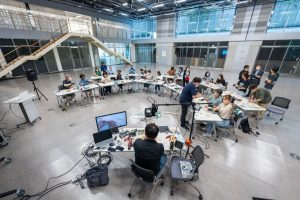
From MIT’s Artificial Intelligence and Decision Making major to USC’s Artificial Intelligence for Business degree, universities are increasingly combining AI with business, finance, data science, the humanities and other disciplines.
This is not simply a matter of adding “AI” to an existing programme’s name.
Universities are competing to educate students who understand both technology and a specific field—and who can use that combination to solve real-world problems.
McKinsey estimates that activities accounting for up to 30% of current working hours in the United States could be automated by 2030. This does not mean that 30% of jobs will disappear. More likely, many occupations will be redesigned, and employers will expect graduates to do more than operate AI tools.
The real question will be:
Can you use AI to solve a meaningful problem?
That is why “AI+X” is more than an admissions trend. For the right student, it may offer a broader and more sustainable academic path.
AI+X Is Reshaping the Curriculum
A traditional interdisciplinary pathway often means completing one major and adding a minor in another subject.
A genuine AI+X programme integrates computing, data and algorithms into the core questions of another field:
- AI+Business: How can AI improve strategy, operations and market decisions?
- AI+Finance: How can it support risk analysis, intelligent investment and financial systems?
- AI+Healthcare: How can algorithms contribute to diagnosis, drug discovery and patient care?
- AI+Humanities: Who should make decisions when technology affects privacy, bias and social fairness?
AI+X graduates may pursue technical careers in areas such as machine learning and AI engineering. Alternatively, they may enter finance, consulting, healthcare or other industries with technical capabilities that traditional professionals may not possess.
The second route deserves particular attention.
AI technology will continue to change rapidly. A deep understanding of an industry’s problems, however, remains much harder to automate.

Carnegie Mellon University: The Undergraduate AI Pioneer
Any discussion of undergraduate AI education should begin with Carnegie Mellon University.
In 2018, CMU launched what it described as the first undergraduate degree in artificial intelligence in the United States—years before the current rush to create AI-branded programmes.
In addition to its BS in Artificial Intelligence, CMU now offers:
- an Additional Major in Artificial Intelligence; and
- a Minor in Artificial Intelligence.
The Additional Major in Artificial Intelligence allows students to retain their primary major while completing substantial coursework in mathematics, computer science, machine learning and AI.
It is open to students across CMU, giving those in engineering, business, the humanities and other disciplines an opportunity to connect AI with their primary field.
However, “open to all students” does not mean “easy for all students.”
CMU explicitly notes that the technical prerequisites may be challenging for students without the necessary background. The programme is best suited to those with strong foundations in mathematics and programming who are prepared for a demanding additional major.

MIT: Artificial Intelligence Is Also About Decision-Making
MIT’s Artificial Intelligence and Decision Making major—Course 6-4—became available for students to declare in Fall 2022.
The curriculum brings together areas traditionally taught across several departments, including:
- electrical engineering;
- computer science;
- statistics;
- operations research; and
- brain and cognitive sciences.
Students learn how systems perceive and interact with the world, process information, make decisions and adapt to changing environments.
Course options include programming, probability, machine learning, control systems, computer vision, robotics and AI decision-making.
The programme is therefore not designed merely to teach students how to use existing AI tools. It develops the mathematical and algorithmic foundations needed to understand how intelligent systems work.
Applicants should not assume that the word “decision” makes this a business-oriented degree. Mathematics will correct that misunderstanding fairly quickly.
USC: Bringing AI into Business Strategy
The BS in Artificial Intelligence for Business at the University of Southern California is offered jointly by the Marshall School of Business and the Viterbi School of Engineering.
USC describes it as the first undergraduate degree in the United States to combine AI with the strategic foundations of business through a fully integrated curriculum.
Students study areas such as:
- business communication and management;
- statistics and data science for business;
- AI principles and foundations;
- hands-on applications of AI; and
- AI technology strategy.
The goal is to develop future business leaders who understand the technology well enough to identify opportunities, communicate with technical teams and guide responsible implementation.
These graduates could be valuable in consulting, finance, technology, entrepreneurship and product management, where organisations need people who can translate between engineers and business decision-makers.
However, this remains a quantitative, STEM-designated programme. It is not a traditional business degree with a little ChatGPT added for decoration.
HKU: Combining AI, Data Science and the Humanities
The University of Hong Kong’s BA & BEng in Artificial Intelligence and Data Science is a five-year double-degree programme.
It combines engineering, computing and data science with critical analysis, ethical reasoning and creative problem-solving from the humanities.
The curriculum includes courses such as:
- Foundations of AI and Humanity;
- Ethics, Society and Law of Artificial Intelligence;
- Human and Machine Cognition;
- AI and data science core courses; and
- interdisciplinary research projects.
The programme addresses one of the most important questions of the AI era:
Technology may tell us what can be done, but human judgment must still determine what should be done.
This double degree may suit students who have strong quantitative abilities while also being interested in ethics, law, human behaviour and social questions. It is less suitable for students seeking only a conventional software-engineering pathway.

PolyU: Connecting AI with Financial Technology
The Hong Kong Polytechnic University has developed several programmes linking artificial intelligence, data science and financial technology.
Its BSc (Hons) in Financial Technology and Artificial Intelligence combines fundamental computing knowledge with:
- artificial intelligence and machine learning;
- software engineering;
- systems security;
- cryptocurrency;
- electronic finance; and
- big-data applications.
For 2026 entry, PolyU’s Data Science and Artificial Intelligence scheme includes pathways in:
- Artificial Intelligence;
- Artificial Intelligence with Financial Technology; and
- Data Science and Analytics.
Some new pathways remain subject to formal approval, so applicants should check the latest university information before applying.
Career possibilities may include financial consulting, AI consulting, financial data analysis, FinTech systems development and entrepreneurship.
The programme offers a clear connection to industry. But students should not select it simply because “AI+Finance” sounds impressive. Without genuine interest in mathematics, programming and finance, four years may feel considerably longer.
Three Questions to Ask Before Choosing AI+X
1. Is the Student Prepared for the Technical Difficulty?
“Interdisciplinary” does not mean less rigorous.
Most AI+X programmes still require calculus, linear algebra, probability, statistics, programming and algorithms. At institutions such as CMU and MIT, the technical demands may equal—or sometimes exceed—those of a conventional computer science pathway.
Students should ask themselves honestly:
Do I enjoy solving problems through mathematics and computation, or do I simply like the idea of studying AI?
2. How Deep Is the “X”?
The strongest AI+X graduates will not have superficial knowledge of two subjects. They will understand one domain deeply and know how to apply AI within it.
AI+Finance cannot consist of AI with almost no finance. AI+Humanities cannot focus entirely on ethical discussion without sufficient technical understanding.
The deeper the “X,” the more defensible the graduate’s long-term professional advantage becomes.
3. Is It a Genuine Programme or Just a New Name?
Universities are introducing AI programmes rapidly, but a fashionable title does not guarantee a strong education.
Applicants should investigate:
- how long the programme has existed;
- which schools or departments are involved;
- whether the curriculum is genuinely integrated;
- the strength of the university’s laboratories and faculty;
- access to internships and industry projects;
- opportunities to work with real data; and
- graduate study and career outcomes.
CMU has been developing undergraduate AI education since 2018. MIT brings deep strengths in engineering, computing and cognitive science. USC combines the resources of a major business school and engineering school.
That institutional depth may matter more than the words “artificial intelligence” appearing in a newly created programme title.
Foundation Global Education’s Perspective
AI+X is not a shortcut around mathematics, programming or subject expertise.
It is best suited to students who are prepared to enter two intellectual worlds and manage the additional complexity that interdisciplinary study brings.
The most valuable future professionals will not simply know how to use AI. They will understand a particular field, identify meaningful problems and exercise sound judgment about when—and how—AI should be applied.
Students should not chase the most fashionable degree title.
They should look for a field in which they are willing to build genuine depth, sustain long-term interest and develop a distinctive combination of skills.
To learn more about AI and interdisciplinary undergraduate programmes, contact Foundation Global Education for personalised university and major-selection guidance.
Programme titles, curricula and approval status may change. Applicants should consult each university’s latest official information.
#CarnegieMellon #MIT #USC #HKU #PolyU #ArtificialIntelligence #AIPrograms #CollegeAdmissions #InterdisciplinaryMajors