An AI “Cheating Tool” Got Him Suspended from Columbia. Meanwhile, 62% of U.S. Students Are Using AI for Homework
In March 2025, Columbia University student Chungin “Roy” Lee attracted national attention after developing an AI tool that provided hidden, real-time assistance during technical job interviews.
Columbia pursued disciplinary action against Lee and his co-founder, although reports indicate that his suspension was ultimately connected to sharing material from a disciplinary hearing—not to using AI in his admissions essay.
His case nevertheless raised a much larger question:
When does AI stop being assistance and start replacing the person being evaluated?
Around the same period, RAND reported that the proportion of American middle school, high school and college students regularly using AI for homework had risen from 48% to 62% between May and December 2025.
Even more strikingly, 67% agreed that greater use of AI for schoolwork could damage students’ critical-thinking skills.
Students are using AI more—and increasingly worrying about what it may be doing to their ability to think.

How AI Is Changing the Way Writing Is Taught
In its article How A.I. Killed Student Writing (and Revived It), The New York Times examined how schools and universities are redesigning writing instruction in response to generative AI.
Because take-home essays have become difficult to monitor, some teachers are bringing writing back into the classroom, where students can be observed as they think, draft and revise.
Assignments are changing too. Instead of asking for predictable summaries, teachers are asking students to connect what they have learned with their own reactions, experiences and interpretations—the kind of writing AI struggles to produce convincingly.
After hearing from nearly 400 high school and university educators, the report found that leading schools are not simply banning AI. They are reconsidering which human abilities education should protect.
And that has serious implications for admissions.
When AI can produce a technically polished essay in seconds, correct grammar is no longer enough. Schools will increasingly look for evidence of independent thought, genuine curiosity and a voice that clearly belongs to the student.

How Top Boarding Schools Are Responding
We reviewed the available academic-integrity and AI guidance from leading boarding schools, including Phillips Exeter Academy, Choate Rosemary Hall, Lawrenceville, St. Paul’s, Milton, Deerfield and Hotchkiss.
Their policies differ, but their underlying position is remarkably consistent:
AI may support learning, but it must not replace thinking.
Some schools set clear restrictions. Others allow individual teachers to determine how AI may be used within a particular course or assignment.
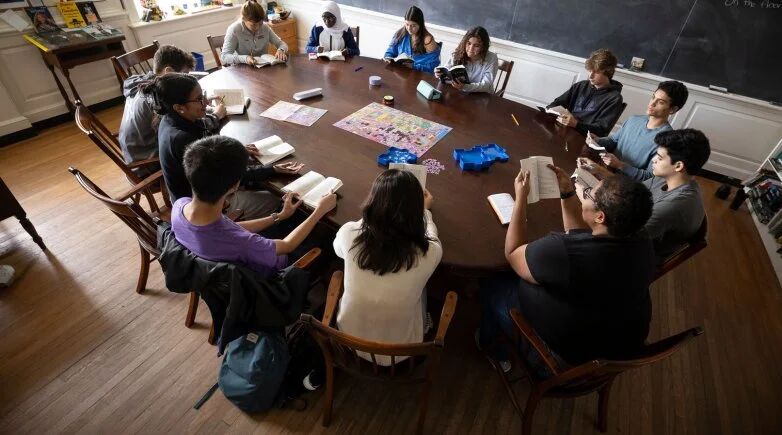
- At Exeter, the Harkness method already creates a natural safeguard: students must think, respond and defend their ideas in real time around the table.
- Choate uses course-specific guidance, allowing teachers to prohibit, limit or actively incorporate AI depending on the learning objectives.
- Lawrenceville focuses on a human-centred framework in which technology must remain in service of independent thought.
- St. Paul’s takes a permission-based approach: students should not assume that AI use is allowed unless a teacher has explicitly authorised it.
- Milton highlights concerns including privacy, bias, copyright and fair assessment.
- Deerfield protects what educators sometimes call “productive struggle”—the difficult but necessary process through which deeper learning occurs.
- Hotchkiss places particular emphasis on the student’s Authentic Voice, both in academic work and in admissions.
- Different rules; one shared message:
The student must remain intellectually present.

The Foundational Skills Becoming More Valuable in the AI Era
Deep Focus
Deep concentration may become one of the rarest—and most valuable—abilities of this generation.
Search engines, recommendation algorithms and constant notifications train the brain to expect rapid stimulation and instant answers. Reading a difficult text for an hour without checking a phone can now feel like an endurance sport.
But real understanding requires the ability to remain with confusion.
Students must tolerate the slow moments: the paragraph that makes no sense, the argument that collapses, the draft that has to be rewritten and the uncomfortable suspicion that their original idea may be wrong.
AI can remove much of this friction. Unfortunately, friction is often where learning happens.
Students who can concentrate deeply, resist distraction and continue thinking when the answer is not immediate will have a significant advantage—not only in admissions, but throughout their future education and careers.
Curiosity and the Ability to Ask Good Questions
When AI can explain how to do something, the more important questions become:
Why should we do it?
Who benefits?
What are we missing?
Is this even the right problem?
AI can generate hundreds of answers, but it cannot independently grow a meaningful question from a student’s lived experience.
A genuinely interesting question may emerge from falling short at something, reading an obscure book, noticing a contradiction in the community or thinking about an issue long after everyone else has moved on.
The most valuable students will not simply know how to operate AI. They will know what to ask of it—and when not to accept its answer.
Independent Judgment and an Authentic Voice
AI is excellent at producing organised, grammatically correct and emotionally polished prose.
It is also excellent at sounding confident when it is wrong—and agreeable when it should challenge you.
Without independent judgment, students risk allowing AI to shape not only how they write, but also what they believe.
This is why Hotchkiss’s emphasis on the Authentic Voice is so important. Future essays will not stand out because they contain the most sophisticated vocabulary. AI can supply sophisticated vocabulary to everyone.
What cannot be mass-produced is the student’s perspective: the community they know, the mistakes they have made, the things they notice and their particular sense of humour.
AI can solve a problem, but it cannot live your life.
It can generate sentences, but it cannot generate your history.

The Problem We See in Admissions Essays
Most students do not lack experiences.
They struggle to understand what those experiences mean—and how to turn them into a story that only they could tell.
A student may have competitions, leadership roles, research, community service and international travel. Yet the essay can still feel generic because it reports achievements without revealing the person behind them.
AI may improve the grammar, but it does not know what the student noticed on their first day at a new school, why a small failure remained painful for years or how a family conversation changed their understanding of responsibility.
Those details create credibility. Reflection gives them meaning.
The goal of essay coaching should therefore not be to manufacture a more impressive student. It should be to help the real student become more visible.
How Students Should Use AI
Leading schools are making one principle increasingly clear:
AI should be the assistant—not the author.
We recommend three responsible uses.
1. Use AI as a Debate Partner
Before writing, ask AI to produce counterarguments or challenge weak assumptions.
This can strengthen the student’s reasoning, provided the student evaluates the responses rather than copying them.
2. Use AI as a Junior Dictionary
AI can help identify spelling errors, grammatical mistakes or possible word choices.
But it should not control the topic, structure, examples or central argument. The student must retain ownership of both the story and its meaning.
Always check the teacher’s or school’s policy first. Even editing assistance may be prohibited for certain assignments.
3. Keep the Power to Ask Questions
Top schools have never simply looked for students who can reproduce correct answers.
They want students who can ask perceptive questions about the world—and who have the patience to pursue those questions beyond the first convenient response.
AI can answer a prompt.
Only a human being can decide which question is worth asking.
Final Thoughts
The collective direction of leading schools is becoming clear: use AI to improve efficiency, but never allow it to replace intellectual development.
Instead of searching for ways to make AI-written work appear human, students should invest in the abilities algorithms cannot easily reproduce—deep focus, curiosity, judgment, self-awareness and authentic expression.
AI may be weakening old-fashioned, mechanical writing assignments. But it may also be forcing schools to bring meaningful writing back: writing that reveals thought, personality and a genuinely lived point of view.
In this new environment, the goal is not to reject the technology.
It is to remain the person holding the reins.
References
School AI policies may be updated and some detailed guidance may only be available through student or parent portals. Students should always confirm the requirements for each course and assignment with their teacher.